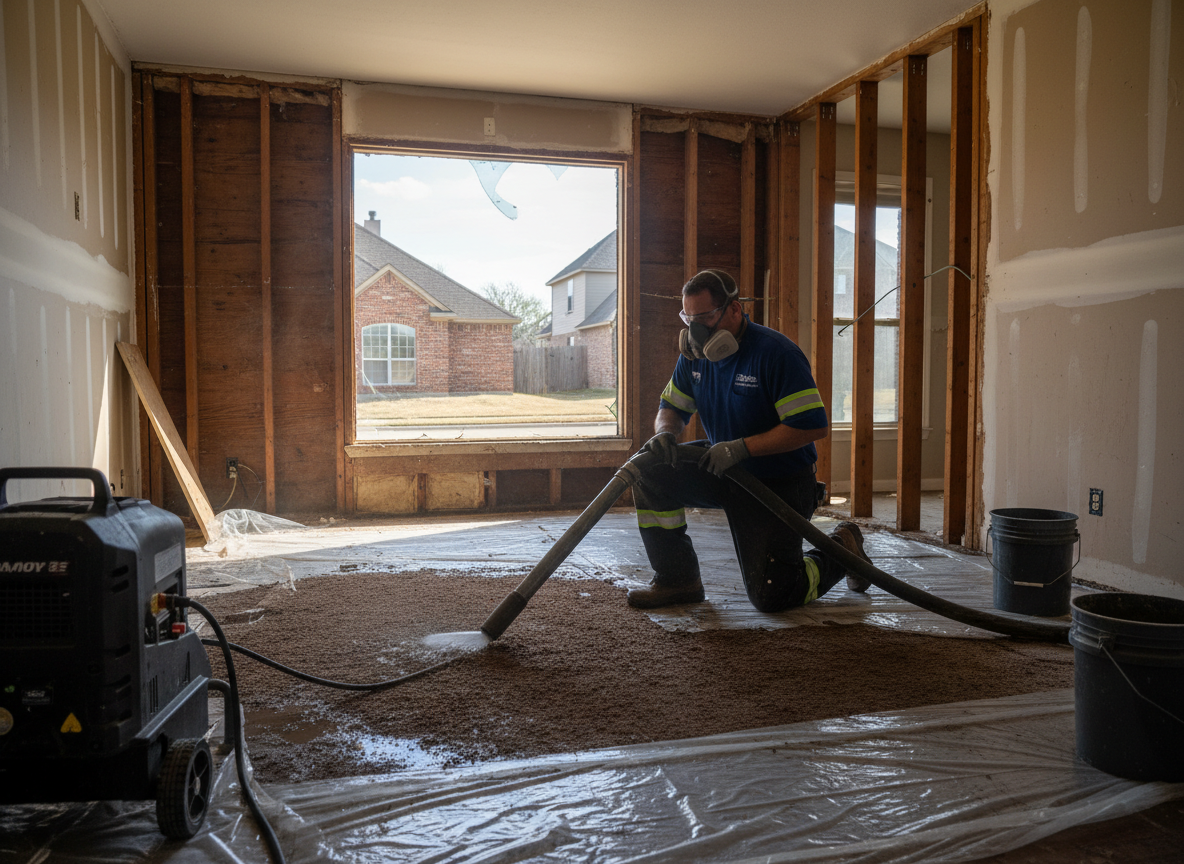
Fort Worth's older housing stock in Arlington Heights and the Stockyards often features plaster walls and slab foundations that trap moisture after leaks. Humid subtropical summers accelerate mold growth behind surfaces, so extraction must reach wall cavities and underfloor areas before secondary damage sets in. Properties near the Kimbell Art Museum and Sundance Square frequently involve mixed commercial-residential construction where water migrates through shared walls, requiring targeted drying to avoid disrupting adjacent units.
Tarrant County terrain and mild winters mean freeze-thaw cycles are rare, yet heavy spring rains and summer storms still overwhelm older gutters and grading around TCU-area homes. Nearby cities like Arlington, Mansfield and Keller share similar clay-heavy soils that shift and crack foundations, allowing water to enter basements or crawl spaces. Repair work here focuses on removing saturated insulation and subflooring while preserving original hardwood where possible.
Technicians routinely address appliance leaks in Cultural District apartments and storm runoff entering low-lying Stockyards structures. Proper drying protocols account for the area's high humidity, which slows evaporation and demands industrial dehumidifiers running longer than in drier climates. Homeowners in these neighborhoods benefit from prompt assessment to limit damage to irreplaceable trim and finishes common in pre-war buildings.
Technician insight
In Fort Worth, the thing that catches most people out with water damage repair is how quickly humidity turns a small roof leak into hidden mold behind plaster in pre-1950 Arlington Heights homes with poor attic ventilation.
Stockyards Area Leak
A roof leak during a summer storm allowed water to travel along ceiling joists in a Stockyards commercial building. Assessment revealed saturated plaster and insulation extending into an adjacent unit. Extraction and targeted drying prevented mold spread, followed by matching plaster repair.
Water Damage Repair Services We Offer
✓Emergency Water Extraction
Rapid removal of standing water from Fort Worth homes after leaks or storms to prevent further saturation of floors and walls.
✓Structural Drying
Industrial drying of walls, ceilings and subfloors in Tarrant County properties using air movers and dehumidifiers suited to local humidity.
✓Basement Water Damage Repair
Repair of water intrusion in Arlington Heights and Stockyards basements, including foundation crack sealing and moisture barrier installation.
✓Ceiling and Wall Repair After Leaks
Restoration of water-damaged plaster and drywall in Downtown and Cultural District buildings while matching original finishes.
✓Flooring Restoration
Salvage and repair of hardwood and tile flooring affected by appliance or roof leaks in TCU and Mansfield-adjacent homes.
Water Damage Repair Cost in Fort Worth, TX
| Service | Typical Range | What Affects It |
|---|---|---|
| Initial Assessment | $125–$225 | Includes moisture readings in multiple rooms |
| Water Extraction | $300–$650 | Depends on volume and access in older homes |
| Structural Drying | $450–$950 | Daily equipment rental and monitoring |
| Wall Or Ceiling Repair | $400–$1,200 | Varies with plaster versus drywall and finish matching |
Ranges are typical for Fort Worth, TX and confirmed with an exact written quote before any work starts.
How it works
- 1
On-Site Assessment
Technicians inspect the affected areas in the specific Fort Worth neighborhood to identify water sources and hidden moisture pockets.
- 2
Water Removal
Extraction equipment removes standing water from floors and cavities before humidity allows mold to develop.
- 3
Drying And Monitoring
Equipment runs until moisture readings return to normal levels, with daily checks adjusted for Tarrant County's climate.
- 4
Repair And Restoration
Damaged materials are replaced or restored to match the home's original construction details.
Pricing
Pricing varies by the volume of water, materials affected and time required for drying in Fort Worth's humid conditions.